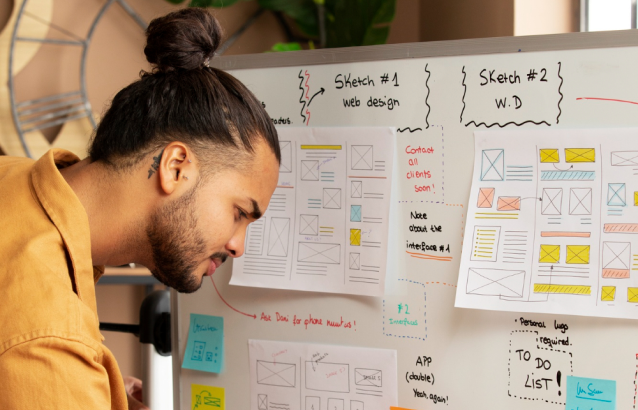


Not long ago, building software meant committing months of development before knowing whether an idea would truly work. Teams invested heavily in features, integrations, and infrastructure—only to discover later that the product didn’t solve a real business problem, wasn’t usable, or didn’t fit naturally into existing processes.
Today, that approach no longer makes sense.
With the right use of technology and AI, product teams can validate ideas faster, smarter, and with far less risk—whether they’re starting from scratch or evolving an existing product.
Prototyping is no longer just about design. It’s about accelerating clarity.
Achieve Peace of Mind with Kodia’s Comprehensive Product Engineering Services
Accelerate your growth with smart product development strategies, cutting-edge technologies, and expert guidance from Kodia.
AI Prototyping as a Core Product Development Strategy
Modern prototyping sits at the intersection of business, usability, and technology. It allows teams to answer the most critical questions early:
Does this solve a real business need?
Does it fit naturally into the user’s workflow?
Does it improve a specific moment in a broader business process?
Is this opportunity worth scaling?
AI has fundamentally changed how quickly we can answer these questions. From intelligent mockups to data-assisted flows and rapid simulations, teams can now test assumptions before committing to full development.
This shift is especially powerful when prototyping is treated not as a one-time step, but as a continuous validation engine throughout the product’s life.
Understanding the Three Phases of the Product Lifecycle
Every digital product—no matter the industry—moves through three core phases:
1. Initial Product Phase: Usability and Business Validation.
This is where ideas are fragile and assumptions are unproven. The goal is not perfection, but learning:
Validate usability
Confirm the real business problem
Test whether the solution fits into existing operations
AI-powered prototyping here allows teams to explore multiple paths quickly, simulate flows, and validate value before overbuilding.
2. Growth Phase: Product Optimization and Feature Validation.
Once the product is live, the focus shifts to:
Improving user experience
Reducing friction
Scaling what works
Prototypes in this phase help test new features, flows, or automations without disrupting production systems.
3. Evolution Phase: Scaling, Integration, and Business Process Expansion.
At maturity, products must adapt—or risk becoming obsolete. This phase often involves:
New use cases
New markets
Deeper integrations
Process optimization
Here, prototyping becomes a way to explore future states of the product and identify new opportunities inside the business process.
Real-World Applications of AI Prototyping Across Industries
Across different industries, we’ve seen how early validation radically changes outcomes.
In merchant-focused software, rapid prototyping allowed us to design and test a custom POS experience tailored to the operational reality of small and mid-size businesses. Instead of forcing generic workflows, prototypes helped validate how sales, inventory, and reporting needed to connect—before building the full system.
In e-commerce product development, prototypes have helped validate checkout flows, inventory synchronization, and post-purchase experiences. Testing these moments early revealed friction points that directly impacted conversion and operational efficiency.
For loyalty application development, prototyping made it possible to validate whether rewards, gamification, and engagement mechanics actually influenced user behavior—or simply added noise. AI-assisted simulations helped prioritize features with real retention impact.
In logistics and operational software, prototypes allowed teams to visualize data flows, handoffs, and system integrations before committing to complex development. This was critical to ensure that technology simplified operations instead of adding another layer of complexity.
In all cases, the value wasn’t speed alone—it was confidence.
AI in Product Development: Accelerating Decisions, Not Replacing Strategy
AI doesn’t replace product thinking. It amplifies it.
When used correctly, AI helps:
- Generate and test multiple solution paths quickly.
- Analyze early user behavior and feedback
Simulate operational scenarios. - Reduce the cost of being wrong early
This allows teams to make better decisions with less risk, especially in the early and evolutionary stages of a product.
Building Software Products That Evolve With Business Needs
The most successful digital products aren’t built once—they evolve continuously. Prototyping, supported by AI, makes that evolution intentional instead of reactive.
It ensures that technology always serves the business:
- Solving real problems
- Supporting real processes
- Creating real value at every stage of the product lifecycle
The question is no longer whether to prototype—but how early and how often you do it.
🚀If you’re exploring a new product idea, refining an existing one, or rethinking how your software supports your business processes, we’d love to talk.
Book a free session with our team to explore how prototyping and AI can accelerate your product’s path from idea to impact.
At KODIA, we combine strategic thinking, product development technologies, and tailored teams to build digital products that drive measurable business results.
Learn More About Product Engineering Strategies From Kodia
- Why product engineering for customer experience is Essential
- Top 7 Essential Product Development Tips for Marketers to Improve Customer Loyalty in 2025
- What is a life cycle roadmap in Product Development?
Ready to turn your vision into momentum?
Let’s build something smart —together.
Explore how our product development strategies can accelerate your growth.