


Product development is no longer just about launching new products — it’s about aligning innovation with business goals, customer needs, and market dynamics. In fact, companies with a strong product development strategy grow 30% faster than those without one.
But here’s the challenge: with so many emerging product development technologies and methodologies, how do you know which path leads to profitability instead of wasted resources?
As Harvard professor Clayton Christensen once said: “Innovation almost always is not about technology. It’s about market insight.”
This article will unpack the importance of product development and strategy, how it impacts businesses and individuals, and the key measures you can take to ensure sustainable growth.
Achieve Peace of Mind with Kodia’s Comprehensive Product Engineering Services
Accelerate your growth with smart product development strategies, cutting-edge technologies, and expert guidance from Kodia.
Why Product Development Strategy Matters Now
Launching a product without a clear product development strategy is like building a house without a blueprint.
- 42% of startups fail due to lack of market need (CB Insights)
- 17% fail because of poor quality or weak differentiation
But those numbers don’t tell the full story. In many cases, the problem isn’t the product itself, but the absence of a structured product development and strategy framework that connects research, design, technology, and go-to-market execution. Without it, even innovative ideas collapse under the weight of unclear priorities and scattered resources.
A strong strategy ensures that every investment of time, talent, and budget is tied to measurable outcomes. It gives leadership visibility across teams, reduces risk by validating assumptions early, and creates alignment between business goals and customer needs.
Without the right strategy, companies risk overinvesting, building in silos, and launching products that don’t connect with the market.
The result?
Missed opportunities, financial waste, and loss of competitive edge .
The Human Side: How Product Development Affects Individuals
Product failures don’t just hurt businesses — they impact people. Behind every launch, there are customers waiting for solutions, employees investing their energy, and partners betting on success.
Impacts on individuals include:
- Customers lose trust in brands that overpromise and underdeliver. Once loyalty is broken, it is difficult and costly to rebuild.
- Employees burn out working on poorly defined projects,unclear requirements, or unrealistic deadlines. This not only affects productivity but also company culture and retention.
- Partners and distributors waste resources pushing products that fail to gain traction, which strains long-term relationships and reduces confidence in future collaborations
The human side is often overlooked when discussing product development strategies, yet it is central: every poor decision ripples outward. When a product fails, it’s not just a balance sheet issue — it’s an emotional and reputational cost.
👉 For product managers and team leaders, this is a clear call: build with strategy, not just speed.
Key Solutions for Effective Product Development
Want better results? Start here:
1. Align Business Goals with Product Roadmaps
Match your product features to company objectives to stay focused on outcomes.
Why it works: Keeps all teams aligned and prevents resource waste.
2. Leverage Product Development Technologies
Use tools like Agile frameworks, AI-driven prototyping, and digital twin simulations.
Why it works: Faster iterations. Fewer expensive mistakes. Reduced risk.
3. Customer-Centric Strategy
Build in customer feedback loops and analytics from the start. (Gartner Research)
Why it works: Real insight prevents building products nobody wants.
4. Cross-Functional Collaboration
Include voices from sales, marketing, engineering, and support.
Why it works: Breaks silos and leads to more complete, market-ready solutions.
Common Challenges in Product Development
Even with a solid product development strategy, companies face evolving hurdles, companies face evolving hurdles. New technologies emerge, customer expectations shift rapidly, and competitors release innovations at record speed. This means that what worked yesterday may not be enough tomorrow.
A common pitfall is treating product development as a linear process instead of a continuous cycle. Market research, testing, and iteration must be ongoing, not occasional checkpoints. Without this mindset, businesses risk investing heavily in solutions that are outdated before they even reach the market.
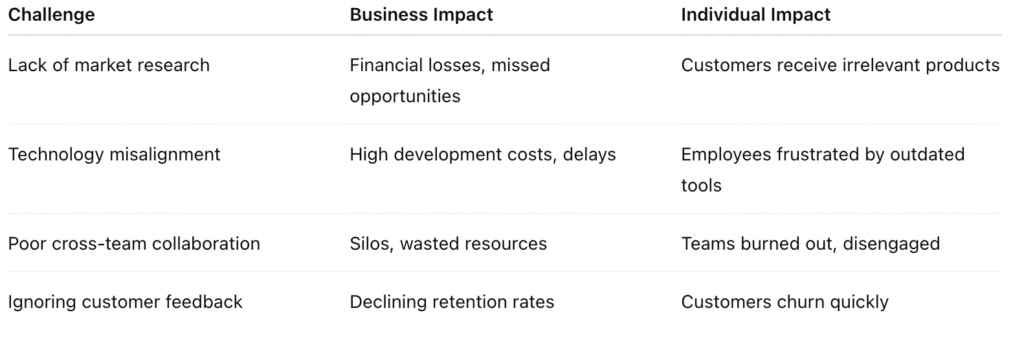
The solution is continuous improvement, not one-time planning.
Conclusion: Build Products with Strategy, Not Guesswork
In today’s market, businesses that treat product development as a guessing game fall behind. Those who treat it as a strategic discipline? They grow faster, serve customers better, and scale smarter.
Sustainable success depends on turning strategy into a living process—where teams are aligned, technologies are leveraged wisely, and customers remain at the center of every decision. Companies that make this shift don’t just survive in competitive industries; they shape the future of them.
At KODIA, we combine strategic thinking, product development technologies, and tailored teams to build digital products that drive measurable business results.
Learn More About Product Engineering Strategies From Kodia
- Why product engineering for customer experience is Essential
- Top 7 Essential Product Development Tips for Marketers to Improve Customer Loyalty in 2025
- What is a life cycle roadmap in Product Development?
Ready to turn your vision into momentum?
Let’s build something smart —together.
Explore how our product development strategies can accelerate your growth.